
Owning Disability, Honoring Gifts: A New Way Forward for 2e Learners


At Lang, we see ourselves as your partner. Raising and educating a twice exceptional child is not a journey that anyone should walk alone. We invite families to partner with us to create the best environment for their child. Together, we can shape a space where each child's disabilities and gifts are understood, supported, and celebrated.
For many families, the word “disability” is heavy. It can feel like a door closing before it has even had a change to fully open. It can carry stigma, misunderstanding, and fear. Parents hear it and worry that their child will be defined only by their challenges rather than their gifts. They worry that schools will see what is difficult and overlook what is extraordinary.

At Lang, we understand those fears. Many of our families come to us after sitting through meetings where the focus has been on deficits and accommodations rather than on potential and strengths. We know how isolating it can feel when your child is described in terms of what they cannot do, instead of the brilliance that lives alongside the challenges.
This is the reality of raising a twice exceptional learner. A student may read at a college level, but struggle with writing a paragraph. They may design complex, beautiful worlds in Minecraft, yet find handwriting almost impossible. They may passionately explain space or Shakespeare, but freeze when given a timed test. They might build entire Lego cities with engineering precision, yet somehow still lose their backpack in their own bedroom. The gifts and the disabilities exist together. They do not cancel each other out. They create a profile that is complex, creative, and often misunderstood.

Each year will bring its share of ups and downs. There will be moments of brilliance and moments of frustration. But at Lang, your child is not walking that path alone. Every student has a team of teachers, specialists, and peers who understand them and support their disabilities and nurture their gifts.
Most traditional classrooms are designed with the idea of an “average” student in mind. For many children, that model works well enough. But for twice-exceptional students, it often misses the mark. A single pace, a single method, or a single structure rarely aligns with the way they learn best. A child who thrives on movement may find long stretches at a desk unbearable (and let’s be honest, most adults do too). A child who needs calm may find noisy, fluorescent lit rooms overwhelming. A student who experiences time differently may appear distracted when, in reality, their brain is simply processing the world at its own rhythm.

In these environments, 2e children often end up spending more effort trying to adapt to the classroom than they do engaging with learning. The problem is not the child. It is that the environment was not built with them in mind.
At Lang, we step into that gap. Thriving does not come from squeezing into a mold. It comes from being seen, supported, and celebrated for who you are. That is why our classrooms are intentionally small and flexible. Our curriculum adapts to the child as we help students to dive deeply into their learning and to develop the skills that they will to navigate the world beyond Lang. Our teachers and specialists design learning experiences that stretch students in their areas of strength and support them where they need help, so both sides of being 2e are addressed.
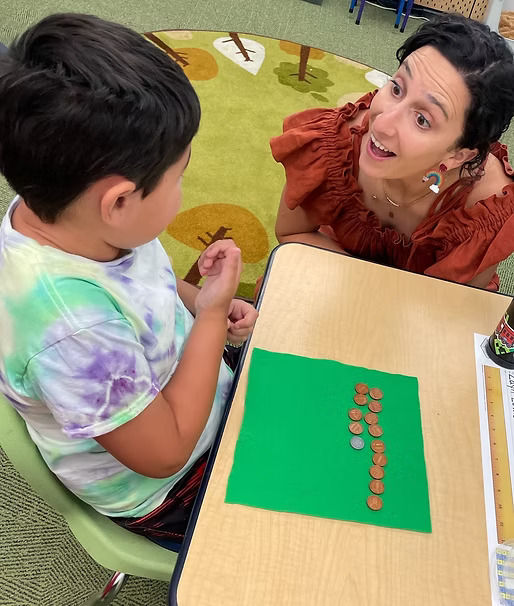
In practice, this looks different for every student. A child who loves the subway might transform a writing assignment into a first person story told from the perspective of a conductor, practicing sequencing and descriptive language in a way that feels natural and exciting. Another child who struggles with executive functioning might map out a long term project with a coach, breaking it into manageable steps on a visual calendar and celebrating progress along the way. A student who is sensitive to sensory input might use headphones or movement breaks as part of their daily rhythm, without feeling singled out or perceived as being disruptive.
These are not exceptions or special allowances. They are the everyday practices that make Lang what it is. Here, students are encouraged to learn in ways that feel authentic to them, and our community is built to honor those differences. When support is built in from the start, children stop using their energy to fit in and start using it to explore, create, and thrive.

At Lang, belonging is not something a child has to earn. It is where they begin. Our school is designed for twice exceptional students from the ground up. Small classes allow us to know every student deeply: their strengths, their struggles, their passions, and their humor. That might mean hearing their case for why recess should be longer than math or their very serious ranking of snack foods. We honor sensory needs, respect different experiences of time, and embrace the quirks that make each child unique. Support is not an afterthought here. It is the foundation.
Lang is authenticity. Lang is empowerment. Lang is a safe place for students to grow into their full selves and to be celebrated for it. It is where children can light up, dig in, and thrive.

Each year will have its challenges, as every year does. But at Lang, your child has an entire team behind them. Together, we make sure that school is not just about getting through the days. It is about growth, confidence, and joy. And part of that work is not being afraid of the word “disability”. A disability does not erase a child’s gifts. It is simply one part of who they are, like naming every Pokémon by memory, but forgetting their lunchbox at school again. With the right support, these challenges can become a source of strength rather than stigma. At Lang, we hold space for both. Because when education is designed for difference, students do not just fit in. They flourish.


Comments